
Bias #4 - Based on Jacqueline Aird's Investigation of the Nature of Bias, p.2
PS
Misrepresentation of Blacks in South African History: When Facts Become Lies
Bias #4 - Based on Jacqueline Aird's Investigation of the Nature of Bias, p.2
What the Textbooks Taught
Textbooks did not merely omit Black people from South African history - they actively distorted their role when they did appear. The Difaqane, a complex period of conflict and migration, was misrepresented. The role of Black people in the making of South African history was underplayed and inaccurately presented.
The Evidence from the Original Document
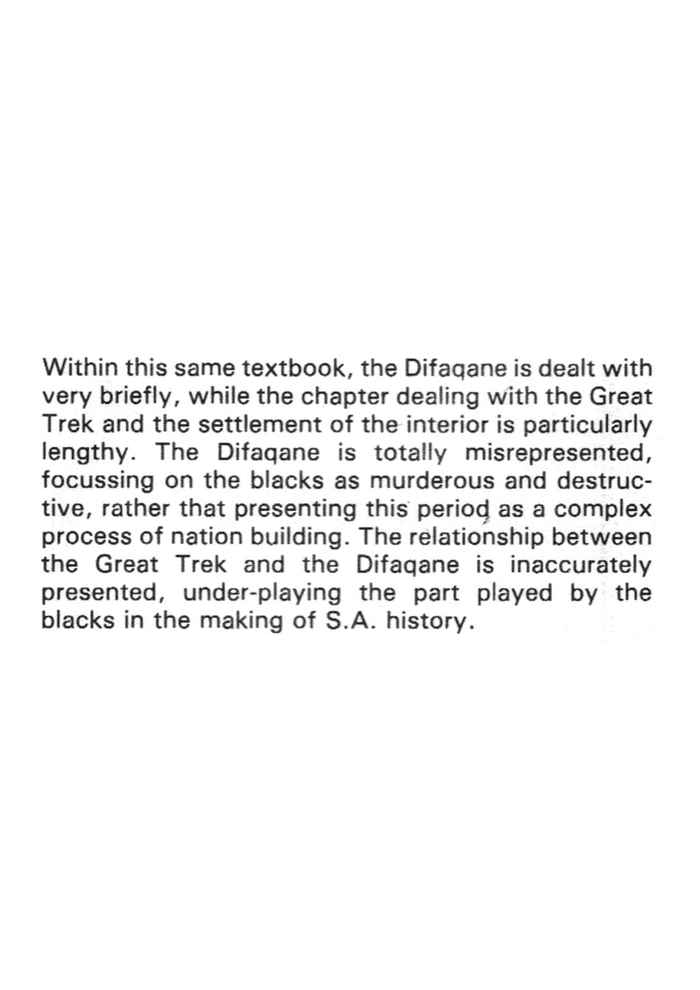
Within the same textbook, the Difaqane is dealt with very briefly, while the chapter dealing with the Great Trek and the settlement of the interior is particularly lengthy. The Difaqane is totally misrepresented, focusing on the blacks as murderous and destructive, rather than presenting this period as a complex process of nation building.
The relationship between the Great Trek and the Difaqane is inaccurately presented, underplaying the part played by the blacks in the making of South African history.
The Bias Exposed
This is active misrepresentation, not mere omission. The Difaqane was a complex historical process involving nation-building, migration, and political reorganisation. But textbooks reduced it to 'murderous and destructive' Black violence. Meanwhile, the Great Trek - which involved similar displacement and conflict was presented as heroic nation-building by white settlers.
The same actions were described differently depending on who performed them. White displacement was 'settlement.' Black displacement was 'destruction.' White conflict was 'struggle.' Black conflict was 'savagery.' This double standard was not accidental - it was a deliberate strategy to portray Black people as obstacles to progress rather than agents of history.
Why It Matters
When history portrays a people as murderous and destructive, it removes the moral basis for their claims to justice. If Black people were only violent, then their dispossession was justified. If they contributed nothing to nation - building, then they have no claim to the nation. These lies were designed to serve colonial interests, not to teach truth.
About This Post
This is the fourth in a five-part series on biases against the Khoi in South African history textbooks, based on Jacqueline Aird's Investigation of the Nature of Bias.