
6 Kaaps
PS
6 Kaaps
By Peter Snyders 6.9.2020
In our 4 Kaaps, we dealt with the tilde (~) in a nasalised vowel in Kora. While Kaaps has lost most of this nasalising feature, this has not happened with the lengthening of a vowel, even though a pidgin speaker likes to keep matters short and typical, to avoid being confused. The phoneme vowel [a] (or a in Kora) is short as in the examples given before. When the vowel is retained a little longer, as in maar, haat, saam, naand, darem, angel, and saans, the drawn-out vowel is written with a macron [ā] or ā (alt + 0257) in Du Plessis’s Kora dictionary.
Some linguists use a: but this may cause punctuation confusion. So, when we write the above words diacritically (to distinguish a universal sound), they would appear thus: [mār], [hāt], [sām], [nānd], [dārem], [āngel], and [sāns] in Kora. In Pidgin-Kaaps, a separate language from Dutch and Kora, we opted for a double when necessary. We would write maar, saam, and saans. The Pidgin-Kaaps would try to avoid anything like macrons, tildes, and the circumflex, ^, (kappie). Please allow us to ignore the influence of nasalisation (caused by [n] and [m]), to which we will return shortly.
The rule of keeping everything short and simple, as we will prove, can sometimes override the elongated sound and return it to the shorter version. Remember, as long as there is a rule, your language remains civilised! When writing in Kaaps, we will not be using the macron. There are enough rules to guide us in our use of ê.
Let us add some rules of Kora regarding the vowels with extended length, which have been copied directly from Kora Chapter Three, pp. 64 to 65 in our hard copy:
In addition to a contrast between oral and nasal production, some of the vowels in Kora (as in most Khoisan languages) may be lengthened. (In Namibian Khoekhoe, long vowels are indicated by means of the macron, as ‘ā’.) Several of the older authors indicate the long vowels of Kora by means of a colon (as for example, ‘a:’), but since this can lead to confusion with ordinary punctuation marks, we have chosen to follow the Namibian convention and use the macron instead.
Nasalised vowels are always long, and because of this predictability, it would be redundant to indicate the feature in the spelling. (Comment: So, this is why [dārem] and [āngel] would be written as [darem] and [angel] if they had to appear in Kora. Some Kaaps writers correctly write gaan as gan. Same rule.)
In our reproductions of the heritage texts and in the Dictionary, we have usually preserved any indications of vowel length that may have been given in the original sources. The reality, though, is that such indications were often only sporadically made, and were not always consistent. In the case of transcriptions made by Lucy Lloyd and Carl Wuras, it seems that their occasional use of a doubled consonant (as in the word ‘torro’ recorded by Wuras for thoro ‘scatter, sow, strew’) was intended to reflect a shortened preceding vowel. (Comment: This is useful to remember when words like nie, die, dit are assimilated [absorbed or incorporated into the preceding word]).
As a basic rule of thumb, the vowel in a word (other than a grammatical morpheme) that consists of just a consonant followed by a vowel (such as bī ‘suckle’) is typically long, while the first vowel in a word that either has a medial consonant (such as koba ‘speak’), or ends in a nasal (such as xon ‘grind’), is most often short. There are many exceptions to this basic principle, though, where these frequently seem to occur in cases where a word is reduplicated or compounded, or where it was perhaps originally so, but has subsequently undergone contraction. (Comment: We have retained Du Plessis’s accents.)
We have highlighted and changed the font colour below to help you focus on the important parts.
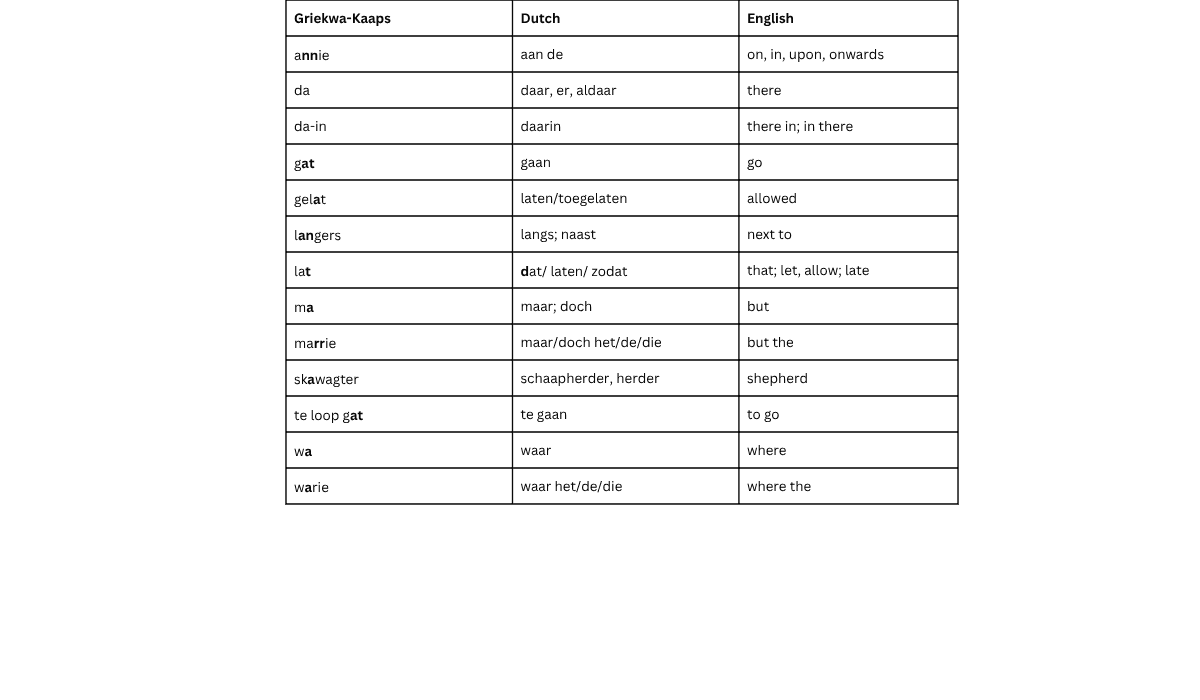
We are not going to comment much on the rules in the above examples because we are progressively going to leave this task to you. If you look at Griekwa-Kaaps and you compare it to the other varieties of Kaaps, you will find many similarities. You will also find some differences. This is because they took the Cape’s Kaaps with them, but, being separated from the source, they adopt their own means for expressing their version of Kaaps.
If they came into daily contact with Afrikaans, they may have some Afrikaans in their current language. This does not always seem to be the case because Apartheid did us all a favour and left us to preserve much of our original Kora-influenced Kaaps because separation causes a degree of language change.
Coloured people having to live in the onderdorp in the country were also allowed to retain some of the Cape Kaaps (not Afrikaans, because it did not exist yet) with them. Note how the unpopularity of p in Kora is still demonstrated by its omission in skawagter but the medial (middle) vowel of the first syllable remains long according to the rule: the middle (medial) vowel of the first syllable in a word is always long.
Apartheid also allowed us to retain many of the older rules. Unfortunately, the third (English-influenced) and fourth (Afrikaans-influenced) phases of Kaaps have forced themselves onto Cape Flats Kaaps. The fifth phase (Modern Kaaps – where the spirit of Kaaps is back in control) is recouping some of its losses. Fortunately, as we can see above, Griekwa has retained much of the old Kora authority. We will confirm this even more when we show examples from Rehoboth-Kaaps and Namakwalands-Kaaps.
You should probably find all Menán du Plessis’s Kora rules above, as well as those we discussed earlier in these examples. We are again just pointing to some clues by making some letters bold. Please look for more and different examples in your own writing as well as the writings of other writers. This is a very time-consuming project, so we try to limit the examples to the contributor who displays the best paradigm (list of illustrative examples).
We will soon look at e, a shorter form of ê with the sign [ε] (alt + 238).