
4.2 Kaaps
PS
4.2 Kaaps
(© 4th September 2020 by Peter Snyders)
In Kora, we find [a] ≈ a appearing in such words as:
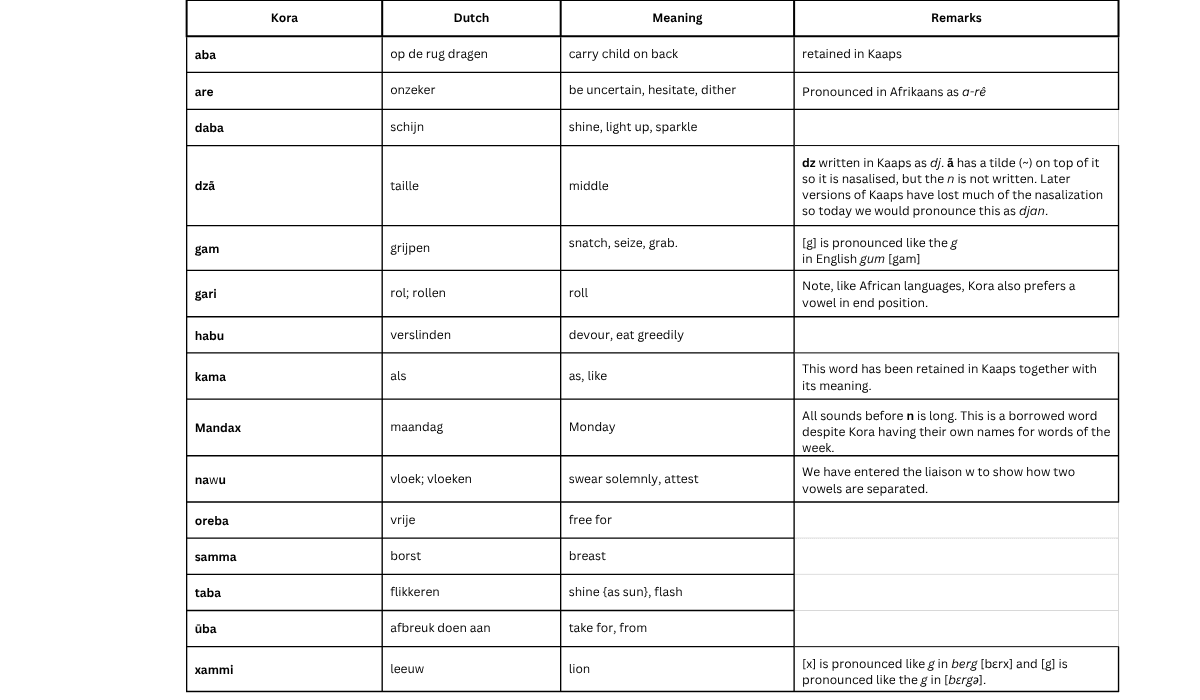
Since all the phonemes in Kora are in bold, i.e., [a] = a, we have taken the opportunity to kill two birds with one stone. While showing where a appears in Kora, we have included the other phonemes. So now you know the other diacritical signs used in Kora; they all sound the same in all languages. Note that there are two pronunciations for the letter g so we have two signs, g and x ([g] and [x]).
The j sound in Jan, which Kora changed to Dj or dz, has the universal phonetic sign [ʤ] (alt + 0676), but for convenience it is written in Kora as dz. The [n] in Kora seldom appears at the end of a word. If a letter before n is nasalised (spoken partly through the nose), it gets a tilde (~) on top, like ã in [ʤãn] (or dzãn in Kora). If ã is followed by a nasal sound/letter like n, m, ng, these sounds are absorbed into the preceding vowel and are therefore omitted. Which means that the Kaaps pronunciation of Jan was no doubt without the n part of the a, i.e., [ʤã].
Always remember that we are only concerned (as far as we can infer) with the origin of Kaaps as a pidgin from 1652 and later until the slaves arrived in large numbers. So, over time, as Kaaps started denasalising sounds (sometimes completely), the [n] phoneme returned so that today we say [ʤan] and write Djan. To prove this rule of changing j to dj in Kaaps and Kora, we draw up a list of similar appearances (called a paradigm) and so prove the rule. We will be using this linguistic method on a variety of cases.
Also note (please refer to the Kora-English dictionary) that the letters C, F, J/Y, L, P, Q, V, W, and the schwa (the e [ə] sound as in English the) sounds either do not appear or are very rare. We will go into these later.
Kaaps did not come from Afrikaans, so Afrikaans is not a reference. We have given Afrikaans a column for any of you who may have problems with Dutch.
More importantly, though, it also allows us to demonstrate how Kaaps has its own words, spirit, and rules which it uses to make foreign words conform to its own inventory (collection of sounds). Our tables also show that Afrikaans is much closer to Dutch than to Kaaps. The English column gives readers who are not very well conversant with the other three languages a good opportunity to see how Kaaps relates to the other two languages. Also, it illustrates why English is the best choice for a metalanguage. It has nearly nothing in common with the three other languages.
In our next letter, we will deal with the longer letter ā as in maar, raam, naat, taamlik, and laat, and how Kaaps modifies the sound with its own rules. We will also show the reason some rules are in a pidgin language. Then we will go into the other vowels, and if the letter is not too long, see what Kaaps does with vowels that are not in its inventory.