
2.3 Kaaps
PS
2.3 Kaaps
(© 4th September 2020 by Peter Snyders).
Let us explain why the Khoikhoi says Djã instead of Jan. So right away, albeit tentatively for now, we know why Kaapsers say dj in place of j in words such as djy (you), Djan (Jan), djêm (jam), djaloers (jealous), djamme (pity, sorry) and Djiesus (Jesus).
This is because the j sound does not occur as an independent phoneme in Kora but is only occasionally introduced between two vowels of a diphthong to facilitate transition (liaison, separation) between them. If you look at the Kora-English Dictionary, you will not find any words containing j. Please also read it up yourself under Approximants in Sounds of Kora on page 18. We will treat j then.
Here are some examples of the [j] to [ʤ] (alt + 0676) from Zulfah Otto-Sallies’s: Diekie vannie Bo-Kaap pp 1-36. This rule is still applied in Modern Kaaps, the fifth phase of Kaaps.
dj ~ [ʤ] in Kaaps (Both Dutch final checks 12.12.2024)
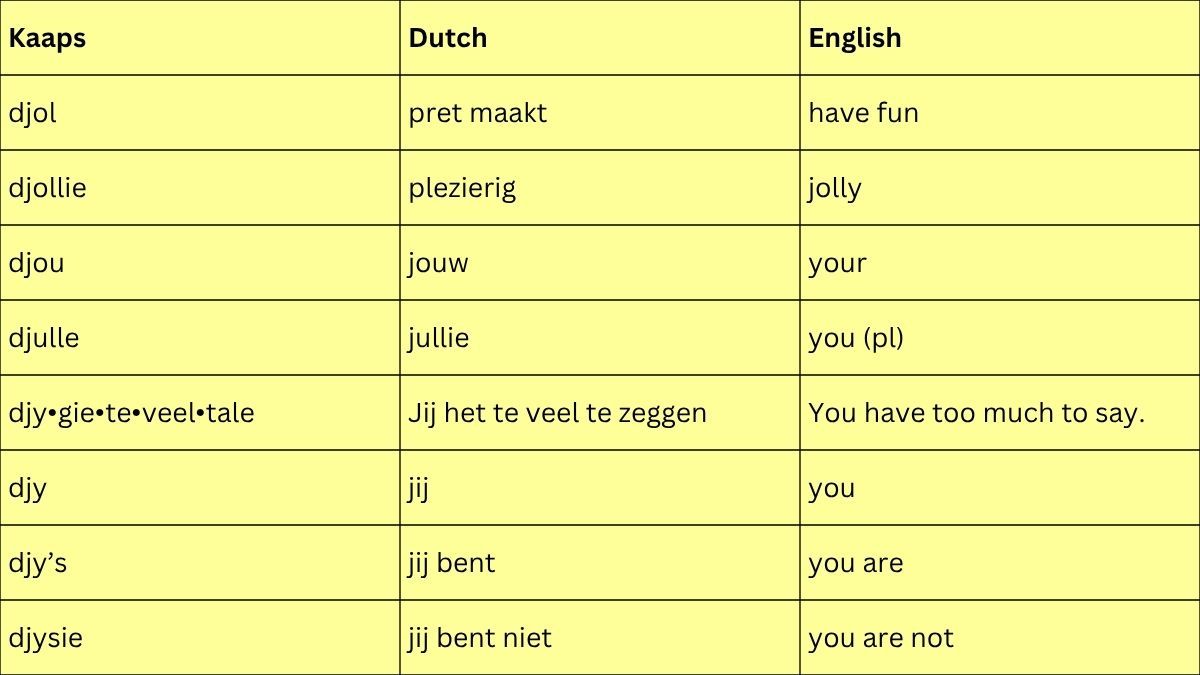
The words djou and djulle are not used by all Kaapsers [speakers of Kaaps]. This is because of some geographical or cultural reasons.
We will be attaching the attachment titled Kora All Variants (and Alternative Spellings) on 28th June 2026 as our last post for June 2026. So, before we move on to n, let us look at disi (ten) on page 1. It says that the d has alternative spellings dj and tj. The tense marker j, because it is a semi-vowel, remote tense marker je (as in signifying the diminutive in Dutch) is substituted by tj as in Kaaps. (page 2)
The nasal n sound rarely occurs in the end-position of a word in Kora.
Please go through the Kora dictionary and see how many words you can find where a word ends with n. As in Kora, so too, Kaaps would either add some more letters after the end n or assimilate (make one) the two or three words. This assimilation also makes Kaaps different from Afrikaans and shows how the Kora rule refused to budge. Below are a few examples from Die Bybel translations of Genesis 1: 1-8. We will attach the names to the numbers in July 2026.
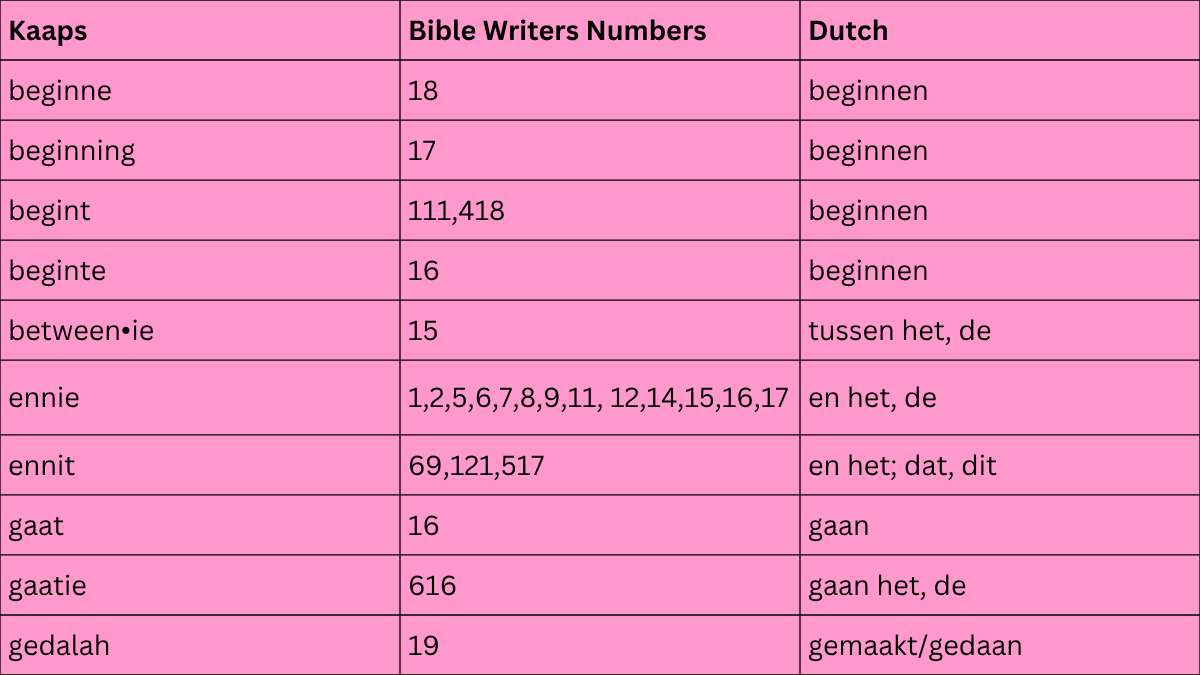
When your spirit (julle’s mos spiritual scientists!) is the true speaker or writer, you will detect the wonderful things that it does. Besides the changing of the –n ending of some examples, 17 goes so far as to use an English word, while 15 not only uses an English word, but also even assimilates (joins) two words from different languages. Sixteen (16) substitutes n with t, while 6 and 16 not only do the same but assimilate (incorporate) the ie of die. 19 proves that Kaaps is a mature language by going so far as to use a completely new/different word to sidestep the problem presented to Kora and, consequently, of Kaaps.
These tables will assist those of you who want to make a dictionary. One of the means chosen by the dictionary creator is frequency, that is, how often the spelling occurs. From the table above, we can see why the spellings of ennie (en die) and ennit (en dit) would be chosen for the dictionary.
All that we have said so far are universal linguistic rules that Kora is applying to create the Pidgin-Kaaps, the first phase of the modern Kaaps spoken today.
A language created without academic interference, like a Pidgin, for example, is done by the Spirit of God.
Matthew 10: 19. But when they deliver you up, take no thought how or what ye shall speak: for it shall be given you in that same hour what ye shall speak.
20. For it is not ye that speak, but the Spirit of your Father which speaketh in you.
Note: We only wanted to work with the [a] in Kaaps, but we cannot use it in isolation. The rule with the only a letter is that it is short. Professor Menán du Plessis, not only dispatched of the different ways the early linguists wrote Kora, but she also turned Kora into an Independent Phonological Entity. This means that everything you see in Kora has a distinct sound. This means that all dj, a and n sounds would always be sounded in their own particular way.
We have the rule that j is adapted to dj or tj as we find not only in our table but also with our diminutives. This is the way all languages work with sounds that do not belong to their lexicon, [the vocabulary of a language]. There is no th in French, so the French substitute it with z. Similarly, several languages, including German and African languages, substitute de in place of th. The phoneme [sound] j is a consonant in Dutch, but it is a semi-vowel in Kora; it is not even recognised as a vowel.
The Dutch rarely pronounce the end r just like the Koranners [Kora speakers] do. So, they will tolerate each other, but when the slaves use the end r, Kora may discard their rule because the Pidgin does not include complications. This is also why there are no clicks, aspirations [audible breath that accompanies or comprises a speech sound], tonalities [the organization of all the tones and harmonies], egressives and nasals consonants in Pidgin-Kaaps. This made Pidgin Kaaps so simple, that everyone, including the Dutch and slaves, could understand the language quickly and so Kaaps became the lingua franca of the Cape Colony.
Write down these rules yourself because that way you show that you understand them.